Research

Labor Economics · Economics of Migration · Political Economy · Economics of Education · Applied Econometrics and Causal Inference

Selected publications

Picture This: Social Distance and the Mistreatment of Migrant Workers

with Toman Barsbai, Vojtěch Bartoš, Victoria Licuanan, Erwin Tiongson and Dean Yang

Journal of Political Economy Microeconomics, 2026, 4(2): 547–582

Abstract

We experimentally study an intervention to reduce mistreatment of Filipino overseas domestic workers (DWs) by their employers. Encouraging DWs to show their employers a family photo while providing a small gift when starting employment reduced DW mistreatment, increased their job satisfaction, and increased the likelihood of contract extension. While generally unaware of the intervention, treated DWs’ families who remained in the Philippines came to view international labor migration more positively. An online experiment with potential employers suggests that the effect operates through a reduction in employers’ perceived social distance from their employees.

BibTeX
@article{Barsbai2026picture,
  author      = {Barsbai, Toman and Bartoš, Vojtěch and Licuanan, Victoria and Steinmayr, Andreas and Tiongson, Erwin and Yang, Dean},
  title       = {{Picture This: Social Distance and the Mistreatment of Migrant Workers}},
  journal     = {Journal of Political Economy Microeconomics},
  year        = {2026},
  volume      = {4},
  number      = {2},
  pages       = {547--582},
  doi         = {10.1086/736930}
}

Coverage: LISER Policy Brief · more
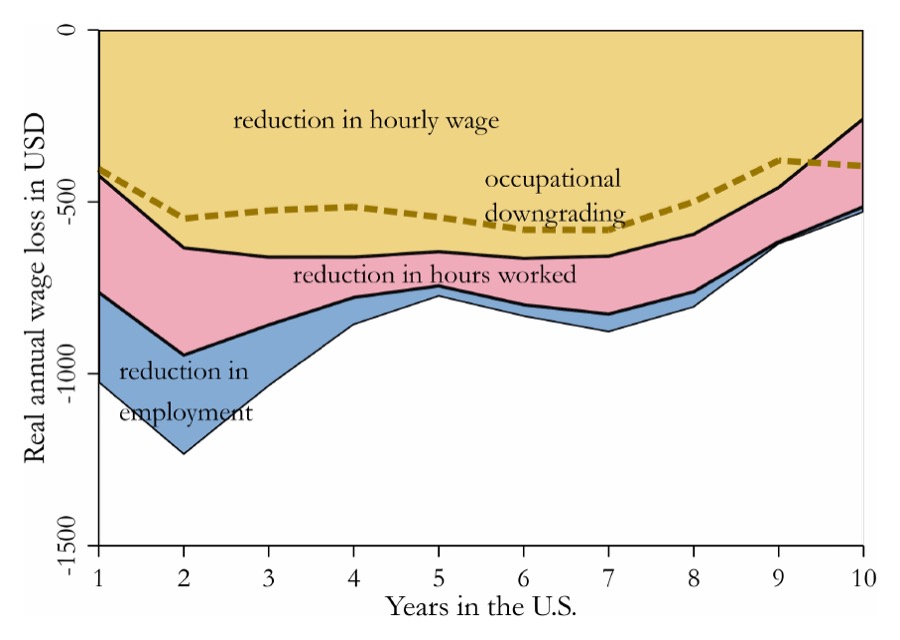
Decomposition of the wage loss

Immigrating into a Recession: Evidence from Family Migrants to the United States

with Toman Barsbai and Christoph Winter

Journal of Labor Economics, 2025, 43(3): 843–883

Abstract

We analyze the impact of economic conditions at arrival on the economic integration of family-sponsored migrants in the United States. A 1 percentage point higher unemployment rate at arrival decreases annual wage income by 4% in the short run and 2% in the longer run. The loss in wage income results primarily from lower hourly wages due to occupational downgrading. Migrant and family networks help mitigate the negative labor market effects. Migrants who arrive during a recession take up occupations with higher concentrations of fellow countrypeople and are more likely to reside with family members, potentially reducing their geographical mobility.

BibTeX
@article{Barsbai2025immigrating,
  author      = {Barsbai, Toman and Steinmayr, Andreas and Winter, Christoph},
  title       = {{Immigrating into a Recession: Evidence from Family Migrants to the United States}},
  journal     = {Journal of Labor Economics},
  year        = {2025},
  volume      = {43},
  number      = {3},
  pages       = {843--883},
  doi         = {10.1086/730121}
}
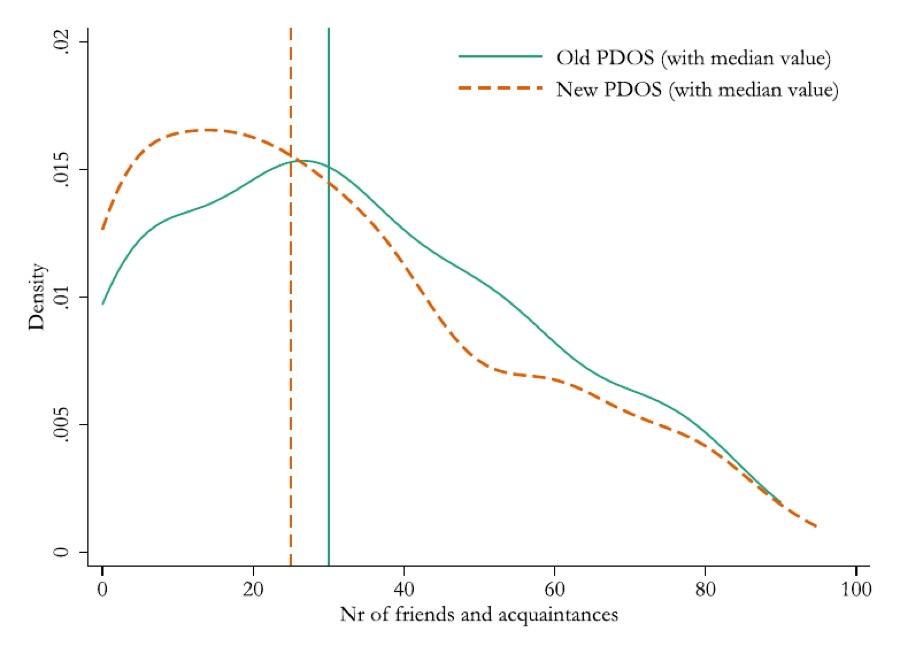
Number of friends, treatment vs. control

Information and Immigrant Settlement

with Toman Barsbai, Victoria Licuanan, Erwin Tiongson and Dean Yang

Journal of Development Economics, 2024, 170: 103305

Abstract

We study a randomly-assigned program providing information on U.S. settlement for new Filipino immigrants. The intervention, a 2.5-hour pre-departure training and an accompanying paper handbook, has no effect on employment, settlement, and subjective wellbeing, but leads immigrants to acquire substantially fewer social network connections. We rationalize these findings with a simple model, showing that information and social network links are substitutes under reasonable assumptions. Consistent with the model, the treatment reduces social network links more when costs of acquiring network links are lower. Offsetting reductions in the acquisition of social network connections can hence reduce the effectiveness of information interventions.

BibTeX
@article{Barsbai2024information,
  author      = {Barsbai, Toman and Licuanan, Victoria and Steinmayr, Andreas and Tiongson, Erwin and Yang, Dean},
  title       = {{Information and Immigrant Settlement}},
  journal     = {Journal of Development Economics},
  year        = {2024},
  volume      = {170},
  pages       = {103305},
  doi         = {10.1016/j.jdeveco.2024.103305}
}

Coverage: J-PAL · Asian Development Bank · more

Asylum applications and far-right support

Contact versus Exposure: Refugee Presence and Voting for the Far Right

The Review of Economics and Statistics, 2021, 103(2): 310–327

Article (PDF)ReplicationAuthor's final version, accepted for publication in REStat (PDF)Young Economists' Award of the Austrian Economic Association (NOeG)
Abstract

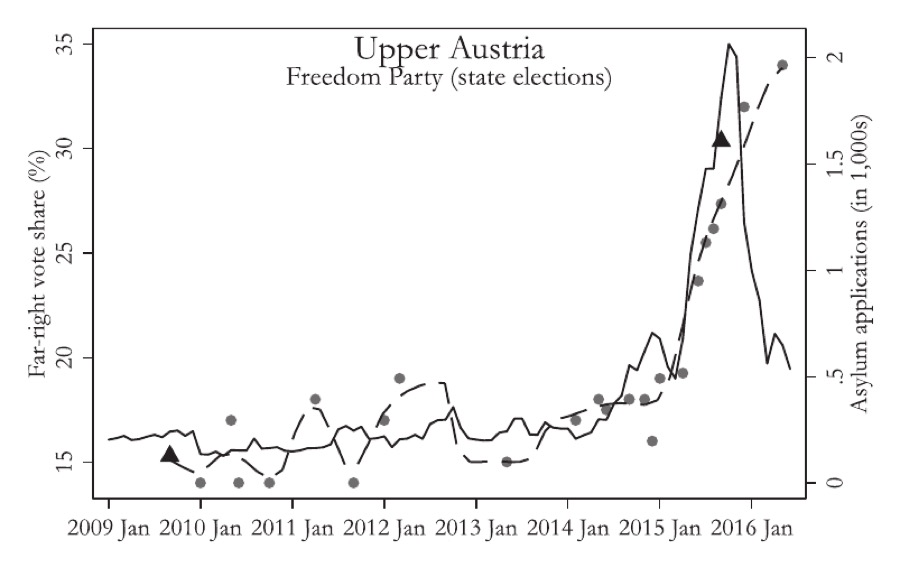
This paper investigates how different forms of exposure to refugees affect voting for Far Right parties. I study the state of Upper Austria where many municipalities hosted asylum seekers and also experienced a massive flow of refugees crossing into Germany in 2015. Exposure to refugees passing through border municipalities increased Far Right votes by about 1.5 percentage points, which suggests that mere exposure can increase Far Right support. Conversely, contact and sustained interactions between natives and asylum seekers in hosting municipalities decreased Far Right votes by about 4 percentage points, which is in line with the intergroup contact theory.

BibTeX
@article{Steinmayr2021contact,
  author      = {Steinmayr, Andreas},
  title       = {{Contact versus Exposure: Refugee Presence and Voting for the Far Right}},
  journal     = {The Review of Economics and Statistics},
  year        = {2021},
  volume      = {103},
  number      = {2},
  pages       = {310--327},
  doi         = {10.1162/rest_a_00922}
}

Coverage: World Development Report 2023 · World Bank–UNHCR Joint Data Center · Die Presse · more

Westward migration and Communist vote

The Effect of Labor Migration on the Diffusion of Democracy: Evidence from a Former Soviet Republic

with Toman Barsbai, Hillel Rapoport and Christoph Trebesch

American Economic Journal: Applied Economics, 2017, 9(3): 36–69

Article (PDF)ReplicationPrize for Scientific Excellence, Research Group on Development Economics of the German Economic Association
Abstract

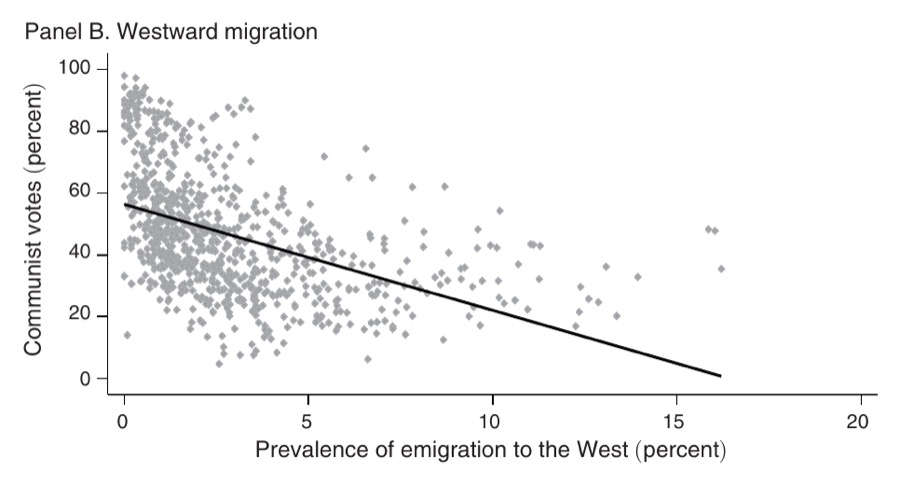
Migration contributes to the circulation of goods, knowledge, and ideas. Using community and individual-level data from Moldova, we show that the emigration wave that started in the aftermath of the Russian crisis of 1998 strongly affected electoral outcomes and political preferences in Moldova during the following decade, eventually contributing to the fall of the last Communist government in Europe. Our results are suggestive of information transmission and cultural diffusion channels. Identification relies on the quasi-experimental context and on the differential effects arising from the fact that emigration was directed both to more democratic Western Europe and to less democratic Russia.

BibTeX
@article{Barsbai2017effect,
  author      = {Barsbai, Toman and Rapoport, Hillel and Steinmayr, Andreas and Trebesch, Christoph},
  title       = {{The Effect of Labor Migration on the Diffusion of Democracy: Evidence from a Former Soviet Republic}},
  journal     = {American Economic Journal: Applied Economics},
  year        = {2017},
  volume      = {9},
  number      = {3},
  pages       = {36--69},
  doi         = {10.1257/app.20150517}
}

Coverage: AEA Chart of the Week · IZA World of Labor · more

Working papers

Employment effects of labor demand and benefits

Opportunities or Benefits: Local Conditions and Refugee Labor Market Integration

with Katia Gallegos Torres and Valentin Wett

RFBerlin Discussion Paper 232/26, 2026

Abstract

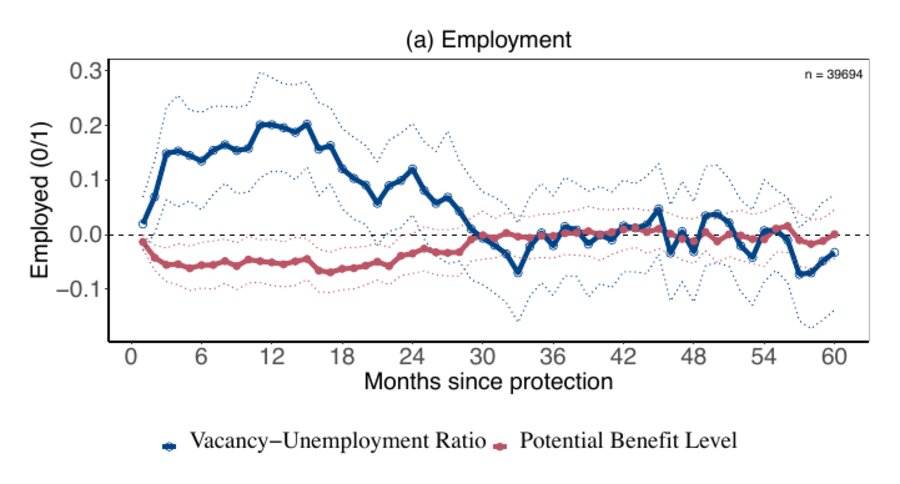
This paper studies how local labor market tightness and welfare benefit levels at the time of receiving protection shape refugees’ labor market integration and location choices. We exploit a sequence of reforms that generated quasi-random variation in benefit levels, together with variation in local labor market tightness across the districts and months in which refugees receive protection. We find that tighter local labor markets raise employment, while more generous benefits slightly reduce it. These employment effects persist for about 2.5 years, but both shocks have lasting impacts on internal migration. Moreover, the negative employment effect of benefits is larger in tighter labor markets. Neither shock affects the probability of emigrating from Austria.

BibTeX
@techreport{GallegosTorres2026opportunities,
  author      = {{Gallegos Torres}, Katia and Steinmayr, Andreas and Wett, Valentin},
  title       = {{Opportunities or Benefits: Local Conditions and Refugee Labor Market Integration}},
  institution = {Rockwool Foundation Berlin},
  type        = {RFBerlin Discussion Paper},
  number      = {232/26},
  year        = {2026}
}
Share of workers with regional accents

The Wage Penalty of Regional Accents

with Jeffrey Grogger and Joachim Winter

NBER Working Paper 26719, 2020

Abstract

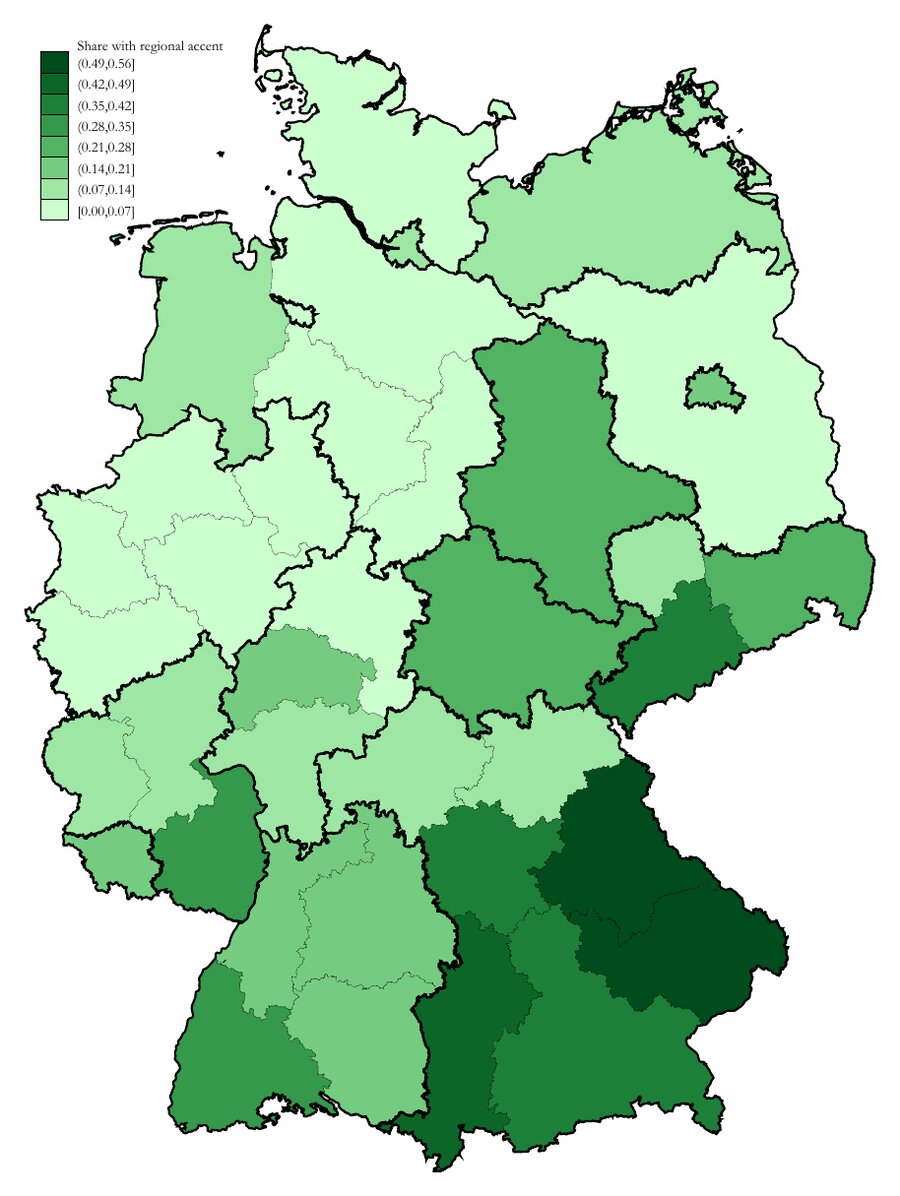
Previous work has documented that speaking one’s native language with an accent distinct from the mainstream is associated with lower wages. In this study, we seek to estimate the causal effect of speaking with a distinctive regional accent, disentangling the effect of the accent from that of omitted variables. We collected data on workers’ speech in Germany, a country with wide variation in regional dialects. We use a variety of strategies in estimation, including an instrumental variables strategy in which the instruments are based on research findings from the linguistics of accent acquisition. All of our estimators show that speaking with a distinctive regional accent reduces wages by an amount that is comparable to the gender wage gap. We also find that workers with distinctive regional accents tend to sort away from occupations that demand high levels of face-to-face contact, consistent with various occupational sorting models.

BibTeX
@techreport{Grogger2020wage,
  author      = {Grogger, Jeffrey and Steinmayr, Andreas and Winter, Joachim},
  title       = {{The Wage Penalty of Regional Accents}},
  institution = {National Bureau of Economic Research},
  type        = {NBER Working Paper},
  number      = {26719},
  year        = {2020},
  doi         = {10.3386/w26719}
}

Coverage: Die Welt · Handelsblatt · more

Illustration of the lower bound

When a Random Sample Is Not Random: Bounds on the Effects of Migration on Household Members Left Behind

Kiel Working Paper 1975, 2017

Abstract

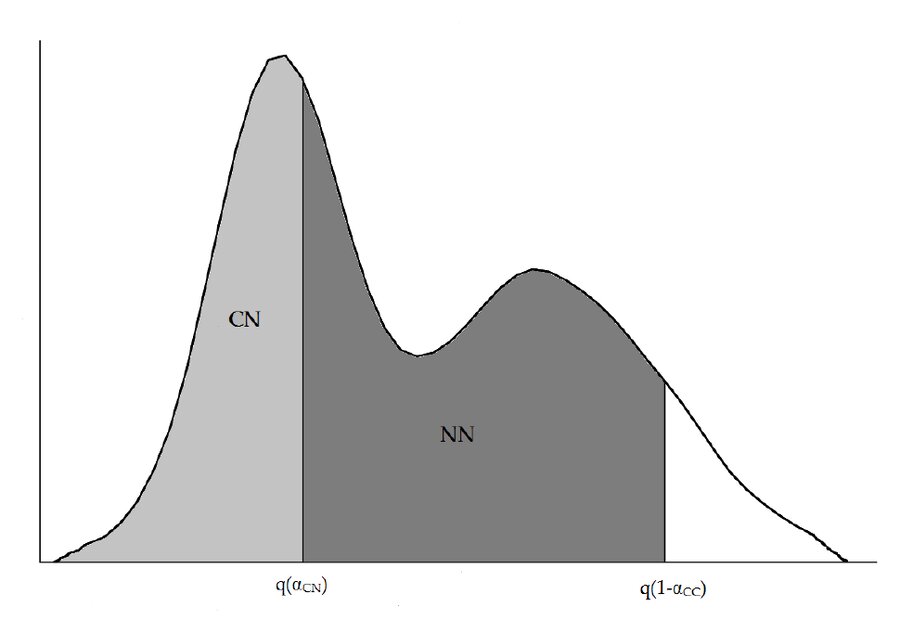
A key problem in the literature on the economics of migration is how emigration of an individual affects households left behind. Answers to this question must confront a problem I refer to as invisible sample selection: when entire households migrate, no information about them remains in their source country. This problem occurs in addition to the question of selection of households into migration, i.e., which households send any migrants. This paper uses principal stratification to address both identification problems simultaneously for a setup with an instrumental variable for the migration of the principal migrant. I derive nonparametric bounds on the effect of migration on remaining household members under varying assumptions and discuss the assumptions implicitly made when the problem is ignored. Building on two widely cited studies, I show that transparent assumptions regarding the behavior of household members and selectivity of migrants allow identification of informative bounds but also that not adjusting for invisible selection may result in substantial bias.

BibTeX
@techreport{Steinmayr2014random,
  author      = {Steinmayr, Andreas},
  title       = {{When a Random Sample Is Not Random: Bounds on the Effects of Migration on Household Members Left Behind}},
  institution = {Kiel Institute for the World Economy},
  type        = {Kiel Working Paper},
  number      = {1975},
  year        = {2017}
}

Coverage: World Bank Development Impact Blog

Peer-reviewed publications

Picture This: Social Distance and the Mistreatment of Migrant Workers

with Toman Barsbai, Vojtěch Bartoš, Victoria Licuanan, Erwin Tiongson and Dean Yang

Journal of Political Economy Microeconomics, 2026, 4(2): 547–582

Abstract

We experimentally study an intervention to reduce mistreatment of Filipino overseas domestic workers (DWs) by their employers. Encouraging DWs to show their employers a family photo while providing a small gift when starting employment reduced DW mistreatment, increased their job satisfaction, and increased the likelihood of contract extension. While generally unaware of the intervention, treated DWs’ families who remained in the Philippines came to view international labor migration more positively. An online experiment with potential employers suggests that the effect operates through a reduction in employers’ perceived social distance from their employees.

BibTeX
@article{Barsbai2026picture,
  author      = {Barsbai, Toman and Bartoš, Vojtěch and Licuanan, Victoria and Steinmayr, Andreas and Tiongson, Erwin and Yang, Dean},
  title       = {{Picture This: Social Distance and the Mistreatment of Migrant Workers}},
  journal     = {Journal of Political Economy Microeconomics},
  year        = {2026},
  volume      = {4},
  number      = {2},
  pages       = {547--582},
  doi         = {10.1086/736930}
}

Coverage: LISER Policy Brief · more
Decomposition of the wage loss

Immigrating into a Recession: Evidence from Family Migrants to the United States

with Toman Barsbai and Christoph Winter

Journal of Labor Economics, 2025, 43(3): 843–883

Abstract

We analyze the impact of economic conditions at arrival on the economic integration of family-sponsored migrants in the United States. A 1 percentage point higher unemployment rate at arrival decreases annual wage income by 4% in the short run and 2% in the longer run. The loss in wage income results primarily from lower hourly wages due to occupational downgrading. Migrant and family networks help mitigate the negative labor market effects. Migrants who arrive during a recession take up occupations with higher concentrations of fellow countrypeople and are more likely to reside with family members, potentially reducing their geographical mobility.

BibTeX
@article{Barsbai2025immigrating,
  author      = {Barsbai, Toman and Steinmayr, Andreas and Winter, Christoph},
  title       = {{Immigrating into a Recession: Evidence from Family Migrants to the United States}},
  journal     = {Journal of Labor Economics},
  year        = {2025},
  volume      = {43},
  number      = {3},
  pages       = {843--883},
  doi         = {10.1086/730121}
}
Number of friends, treatment vs. control

Information and Immigrant Settlement

with Toman Barsbai, Victoria Licuanan, Erwin Tiongson and Dean Yang

Journal of Development Economics, 2024, 170: 103305

Abstract

We study a randomly-assigned program providing information on U.S. settlement for new Filipino immigrants. The intervention, a 2.5-hour pre-departure training and an accompanying paper handbook, has no effect on employment, settlement, and subjective wellbeing, but leads immigrants to acquire substantially fewer social network connections. We rationalize these findings with a simple model, showing that information and social network links are substitutes under reasonable assumptions. Consistent with the model, the treatment reduces social network links more when costs of acquiring network links are lower. Offsetting reductions in the acquisition of social network connections can hence reduce the effectiveness of information interventions.

BibTeX
@article{Barsbai2024information,
  author      = {Barsbai, Toman and Licuanan, Victoria and Steinmayr, Andreas and Tiongson, Erwin and Yang, Dean},
  title       = {{Information and Immigrant Settlement}},
  journal     = {Journal of Development Economics},
  year        = {2024},
  volume      = {170},
  pages       = {103305},
  doi         = {10.1016/j.jdeveco.2024.103305}
}

Coverage: J-PAL · Asian Development Bank · more

Vaccination rates by GP type

Vaccine-Skeptic Physicians and Patient Vaccination Decisions

with Manuel Rossi

Health Economics, 2024, 33(3): 509–525

Abstract

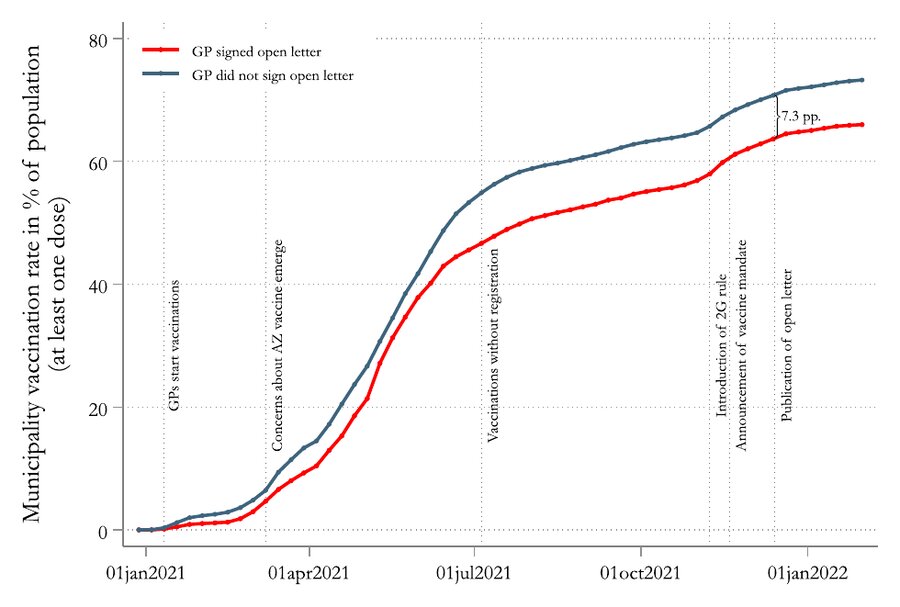
What is the role of general practitioners (GPs) in supporting or hindering public health efforts? We investigate the influence of vaccine-skeptic GPs on their patients' decisions to get a COVID-19 vaccination. We identify vaccine-skeptic GPs from the signatories of an open letter in which 199 Austrian physicians expressed their skepticism about COVID-19 vaccines. We examine small rural municipalities where patients choose a GP primarily based on geographic proximity. These vaccine-skeptic GPs reduced the vaccination rate by 5.6 percentage points. This estimate implies that they discouraged 7.9% of the vaccinable population. The effect appears to stem from discouragement rather than rationing vaccine access.

BibTeX
@article{Steinmayr2024vaccine,
  author      = {Steinmayr, Andreas and Rossi, Manuel},
  title       = {{Vaccine-Skeptic Physicians and Patient Vaccination Decisions}},
  journal     = {Health Economics},
  year        = {2024},
  volume      = {33},
  number      = {3},
  pages       = {509--525},
  doi         = {10.1002/hec.4781}
}

Coverage: APA · Die Presse · Tiroler Tageszeitung · more

Asylum applications and far-right support

Contact versus Exposure: Refugee Presence and Voting for the Far Right

The Review of Economics and Statistics, 2021, 103(2): 310–327

Article (PDF)ReplicationAuthor's final version, accepted for publication in REStat (PDF)Young Economists' Award of the Austrian Economic Association (NOeG)
Abstract

This paper investigates how different forms of exposure to refugees affect voting for Far Right parties. I study the state of Upper Austria where many municipalities hosted asylum seekers and also experienced a massive flow of refugees crossing into Germany in 2015. Exposure to refugees passing through border municipalities increased Far Right votes by about 1.5 percentage points, which suggests that mere exposure can increase Far Right support. Conversely, contact and sustained interactions between natives and asylum seekers in hosting municipalities decreased Far Right votes by about 4 percentage points, which is in line with the intergroup contact theory.

BibTeX
@article{Steinmayr2021contact,
  author      = {Steinmayr, Andreas},
  title       = {{Contact versus Exposure: Refugee Presence and Voting for the Far Right}},
  journal     = {The Review of Economics and Statistics},
  year        = {2021},
  volume      = {103},
  number      = {2},
  pages       = {310--327},
  doi         = {10.1162/rest_a_00922}
}

Coverage: World Development Report 2023 · World Bank–UNHCR Joint Data Center · Die Presse · more

Unemployment duration by group and year

A Framework for Separating Individual-Level Treatment Effects From Spillover Effects

with Martin Huber

Journal of Business & Economic Statistics, 2021, 39(2): 422–436

Abstract

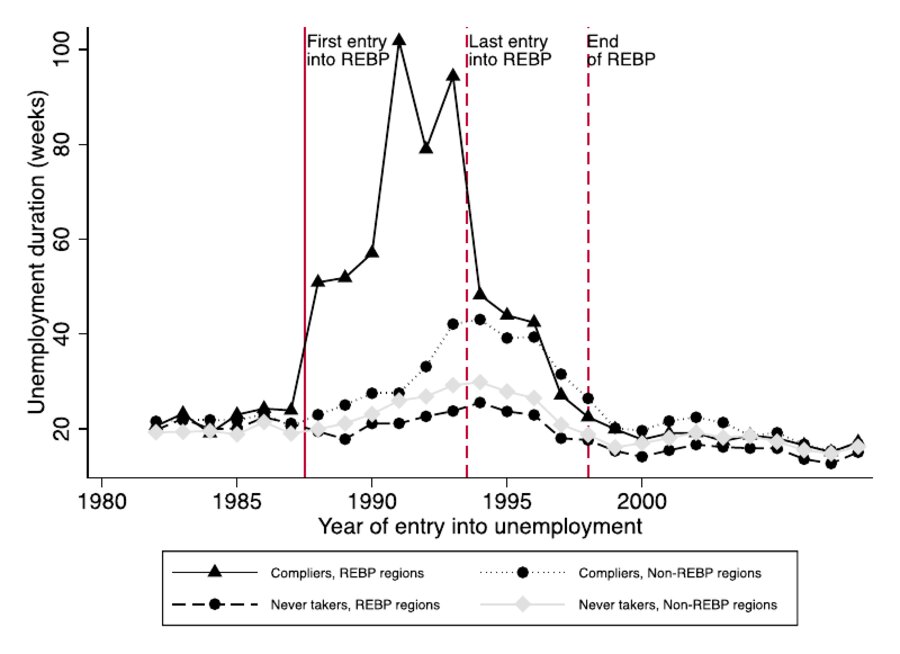
This article suggests a causal framework for separating individual-level treatment effects and spillover effects such as general equilibrium, interference, or interaction effects related to treatment distribution. We relax the stable unit treatment value assumption assuming away treatment-dependent interaction between study participants and permit spillover effects within aggregates, for example, regions. Based on our framework, we systematically categorize the individual-level and spillover effects considered in the previous literature and clarify the assumptions required for identification under different designs, for instance, based on randomization or selection on observables. Furthermore, we propose a novel difference-in-differences approach and apply it to a policy intervention extending unemployment benefit durations in selected regions of Austria that arguably affected ineligibles in treated regions through general equilibrium effects in local labor markets.

BibTeX
@article{Huber2021framework,
  author      = {Huber, Martin and Steinmayr, Andreas},
  title       = {{A Framework for Separating Individual-Level Treatment Effects From Spillover Effects}},
  journal     = {Journal of Business \& Economic Statistics},
  year        = {2021},
  volume      = {39},
  number      = {2},
  pages       = {422--436},
  doi         = {10.1080/07350015.2019.1668795}
}

An Introduction to the Economics of Immigration in OECD Countries

with Anthony Edo, Lionel Ragot, Hillel Rapoport, Sulin Sardoschau and Arthur Sweetman

Canadian Journal of Economics, 2020, 53(4): 1365–1403

Abstract

The share of the foreign-born population in member countries of the OECD is increasing, and this article summarizes economics research on the effects of immigration in those nations. Four broad topics are addressed: labour market issues, fiscal questions, the political economy of immigration, and productivity and international trade. Extreme concerns about deleterious labour market and fiscal impacts following from new immigrants are not found to be warranted. However, it is also clear that government policies and practices regarding the selection and integration of new migrants affect labour market, fiscal, social and cultural outcomes. Policies that are well informed, well crafted and well executed beneficially improve population welfare.

BibTeX
@article{Edo2020introduction,
  author      = {Edo, Anthony and Ragot, Lionel and Rapoport, Hillel and Sardoschau, Sulin and Steinmayr, Andreas and Sweetman, Arthur},
  title       = {{An Introduction to the Economics of Immigration in OECD Countries}},
  journal     = {Canadian Journal of Economics},
  year        = {2020},
  volume      = {53},
  number      = {4},
  pages       = {1365--1403},
  doi         = {10.1111/caje.12482}
}
Weekly gym visits, 2013 cohort

The Effects of Incentives to Exercise on Student Performance in College

with Hans Fricke and Michael Lechner

Economics of Education Review, 2018, 66: 14–39

Abstract

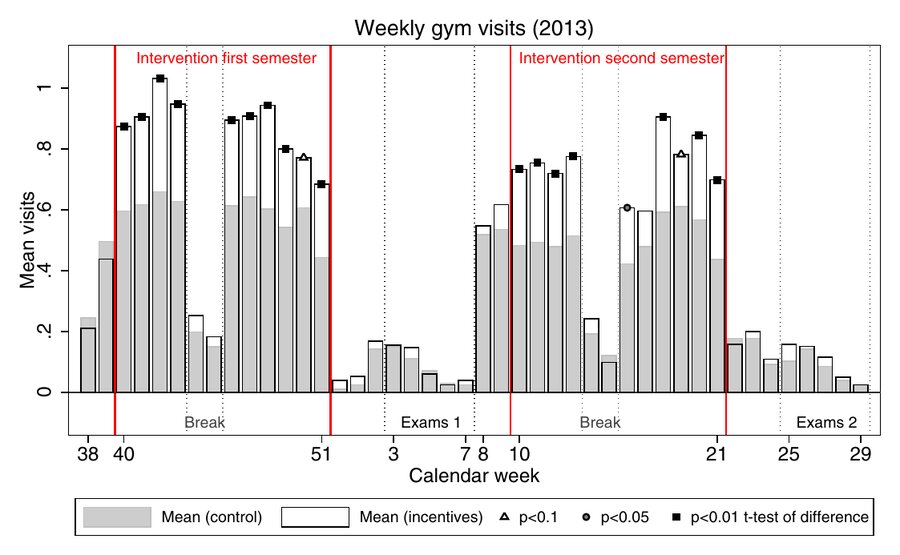
What are the effects of on-campus recreational sports and exercise on educational outcomes of university students? We randomize financial incentives to encourage students’ participation in on-campus sports and exercise in two cohorts of college freshmen. Incentives increased participation frequency by 47% and improved grades by 0.14 standard deviations in the first cohort. The incentives were less effective in promoting participation and did not improve grades in the second cohort. In the first cohort, students primarily substituted off-campus with on-campus physical activities and seemed more able to integrate exercising with studying. The incentives appear to have improved grades by enhancing the effectiveness of studying and encouraging students to spend more time in class.

BibTeX
@article{Fricke2018effects,
  author      = {Fricke, Hans and Lechner, Michael and Steinmayr, Andreas},
  title       = {{The Effects of Incentives to Exercise on Student Performance in College}},
  journal     = {Economics of Education Review},
  year        = {2018},
  volume      = {66},
  pages       = {14--39},
  doi         = {10.1016/j.econedurev.2018.06.009}
}
Economics major choice by JEL code

Exposure to Academic Fields and College Major Choice

with Hans Fricke and Jeffrey Grogger

Economics of Education Review, 2018, 64: 199–213

Abstract

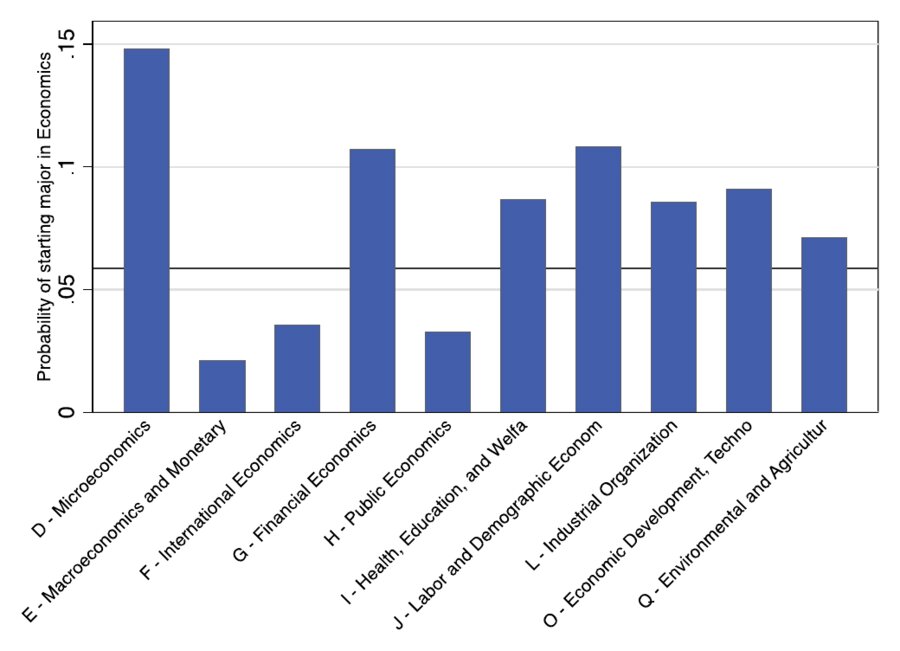
This study investigates how exposure to a field of study influences students’ major choices. If students have incomplete information, exposure potentially helps them to learn about the scope of a field as well as how well the field matches their interest and abilities. We exploit a natural experiment where university students have to write a research paper in business, economics, or law during their first year before they choose a major. Due to oversubscription of business papers, the field of the paper is assigned quasi-randomly. We find that writing in economics raises the probability of majoring in economics by 2.7 percentage points. We show further that this effect varies across subfields: the effect is driven by assignment to topics less typical of the public's perception of the field of economics, suggesting students learn through exposure that the field is broader than they thought.

BibTeX
@article{Fricke2018exposure,
  author      = {Fricke, Hans and Grogger, Jeffrey and Steinmayr, Andreas},
  title       = {{Exposure to Academic Fields and College Major Choice}},
  journal     = {Economics of Education Review},
  year        = {2018},
  volume      = {64},
  pages       = {199--213},
  doi         = {10.1016/j.econedurev.2018.04.007}
}
Westward migration and Communist vote

The Effect of Labor Migration on the Diffusion of Democracy: Evidence from a Former Soviet Republic

with Toman Barsbai, Hillel Rapoport and Christoph Trebesch

American Economic Journal: Applied Economics, 2017, 9(3): 36–69

Article (PDF)ReplicationPrize for Scientific Excellence, Research Group on Development Economics of the German Economic Association
Abstract

Migration contributes to the circulation of goods, knowledge, and ideas. Using community and individual-level data from Moldova, we show that the emigration wave that started in the aftermath of the Russian crisis of 1998 strongly affected electoral outcomes and political preferences in Moldova during the following decade, eventually contributing to the fall of the last Communist government in Europe. Our results are suggestive of information transmission and cultural diffusion channels. Identification relies on the quasi-experimental context and on the differential effects arising from the fact that emigration was directed both to more democratic Western Europe and to less democratic Russia.

BibTeX
@article{Barsbai2017effect,
  author      = {Barsbai, Toman and Rapoport, Hillel and Steinmayr, Andreas and Trebesch, Christoph},
  title       = {{The Effect of Labor Migration on the Diffusion of Democracy: Evidence from a Former Soviet Republic}},
  journal     = {American Economic Journal: Applied Economics},
  year        = {2017},
  volume      = {9},
  number      = {3},
  pages       = {36--69},
  doi         = {10.1257/app.20150517}
}

Coverage: AEA Chart of the Week · IZA World of Labor · more

Sports and Child Development

with Christina Felfe and Michael Lechner

PLOS ONE, 2016, 11(5): e0151729

Abstract

The role of curricular activities for the formation of education, health and behavioural outcomes has been widely studied. Yet, the role of extra-curricular activities has received little attention. This study analyzes the effect of participation in sports clubs—one of the most popular extra-curricular activities among children. We use alternative datasets and flexible semi-parametric estimation methods with a specific way to use the panel dimension of the data to address selection into sports. We find positive and robust effects on children’s school performance and peer relations. Crowding out of passive leisure activities can partially explain the effects.

BibTeX
@article{Felfe2016sports,
  author      = {Felfe, Christina and Lechner, Michael and Steinmayr, Andreas},
  title       = {{Sports and Child Development}},
  journal     = {PLOS ONE},
  year        = {2016},
  volume      = {11},
  number      = {5},
  pages       = {e0151729},
  doi         = {10.1371/journal.pone.0151729}
}

Coverage: IZA World of Labor · more

Migrant donations by purpose, 1990–2010

The Drivers of Diaspora Donations for Development: Evidence from the Philippines

with Victoria Licuanan and Toman Barsbai

World Development, 2015, 65: 94–109

Abstract

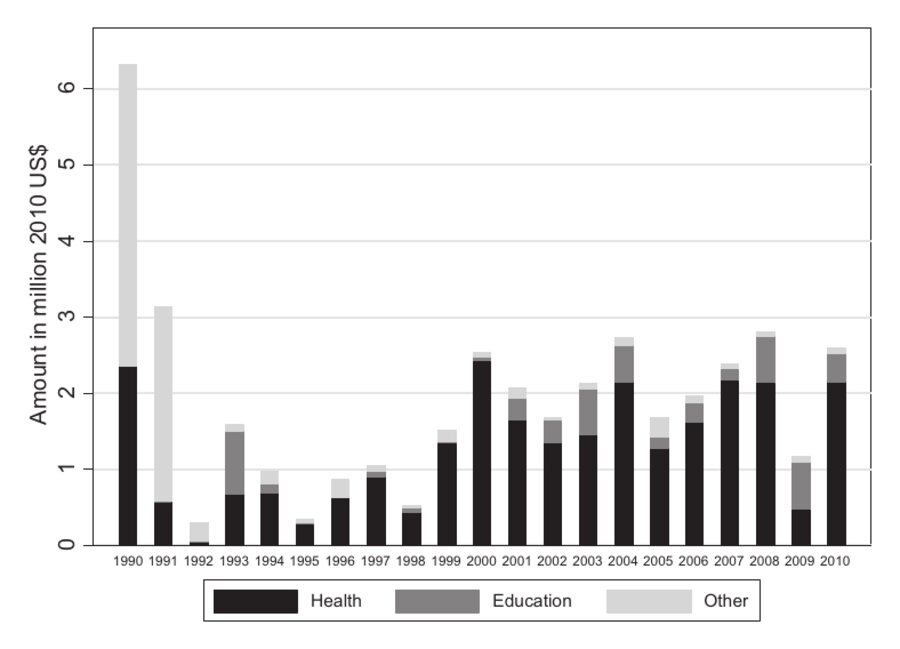
Using administrative data on donations channeled through the Commission on Filipinos Overseas, this paper explores which host and home country factors are associated with donations made by permanent migrants to the Philippines. On the host country side, donations increase with the income level of Filipinos and with the number of hate crimes against minorities. On the home country side, donations are not well-targeted. As donations mainly flow to provinces with high emigration rates, they do not reach less developed Philippine provinces. However, the diaspora is responsive to natural disasters and channels donations to provinces when they are hit by a typhoon.

BibTeX
@article{Licuanan2015drivers,
  author      = {Licuanan, Victoria and {Omar Mahmoud}, Toman and Steinmayr, Andreas},
  title       = {{The Drivers of Diaspora Donations for Development: Evidence from the Philippines}},
  journal     = {World Development},
  year        = {2015},
  volume      = {65},
  pages       = {94--109},
  doi         = {10.1016/j.worlddev.2014.05.010}
}

Radius Matching on the Propensity Score with Bias Adjustment: Tuning Parameters and Finite Sample Behaviour

with Martin Huber and Michael Lechner

Empirical Economics, 2015, 49(1): 1–31

Abstract

Using a simulation design that is based on empirical data, a recent study by Huber et al. (J Econom 175:1–21, 2013) finds that distance-weighted radius matching with bias adjustment as proposed in Lechner et al. (J Eur Econ Assoc 9:742–784, 2011) is competitive among a broad range of propensity score-based estimators used to correct for mean differences due to observable covariates. In this companion paper, we further investigate the finite sample behaviour of radius matching with respect to various tuning parameters. The results are intended to help the practitioner to choose suitable values of these parameters when using this method, which has been implemented in the software packages GAUSS, STATA and R.

BibTeX
@article{Huber2015radius,
  author      = {Huber, Martin and Lechner, Michael and Steinmayr, Andreas},
  title       = {{Radius Matching on the Propensity Score with Bias Adjustment: Tuning Parameters and Finite Sample Behaviour}},
  journal     = {Empirical Economics},
  year        = {2015},
  volume      = {49},
  number      = {1},
  pages       = {1--31},
  doi         = {10.1007/s00181-014-0847-1}
}
Distance to nearest gym by sports participation

Proximity to Sports Facilities and Sports Participation for Adolescents in Germany

with Anne K. Reimers, Matthias Wagner, Seraphim Alvanides, Miriam Reiner, Steffen Schmidt and Alexander Woll

PLOS ONE, 2014, 9(3): e93059

Abstract

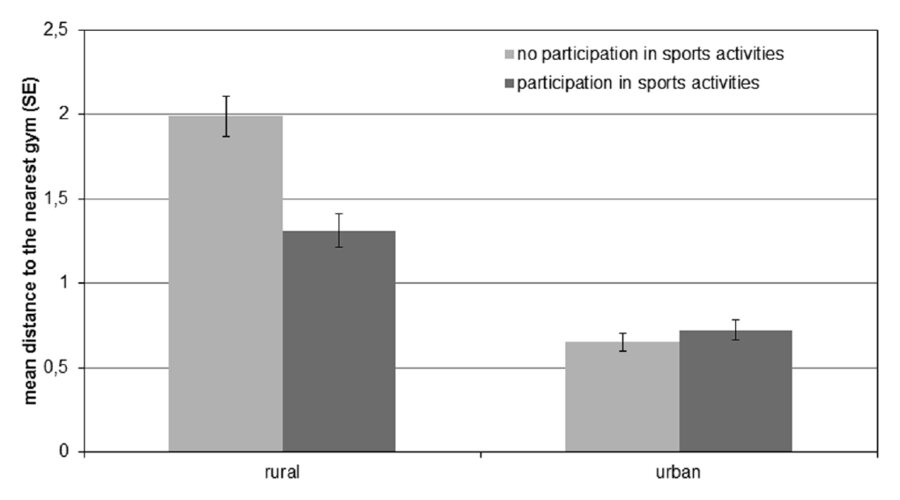
Objectives: To assess the relationship between proximity to specific sports facilities and participation in the corresponding sports activities for adolescents in Germany. Methods: A sample of 1,768 adolescents aged 11–17 years old and living in 161 German communities was examined. Distances to the nearest sports facilities were calculated as an indicator of proximity to sports facilities using Geographic Information Systems (GIS). Participation in specific leisure-time sports activities in sports clubs was assessed using a self-report questionnaire and individual-level socio-demographic variables were derived from a parent questionnaire. Community-level socio-demographics as covariates were selected from the INKAR database, in particular from indicators and maps on land development. Logistic regression analyses were conducted to examine associations between proximity to the nearest sports facilities and participation in the corresponding sports activities. Results: The logistic regression analyses showed that girls residing longer distances from the nearest gym were less likely to engage in indoor sports activities; a significant interaction between distances to gyms and level of urbanization was identified. Decomposition of the interaction term showed that for adolescent girls living in rural areas participation in indoor sports activities was positively associated with gym proximity. Proximity to tennis courts and indoor pools was not associated with participation in tennis or water sports, respectively. Conclusions: Improved proximity to gyms is likely to be more important for female adolescents living in rural areas.

BibTeX
@article{Reimers2014proximity,
  author      = {Reimers, Anne K. and Wagner, Matthias and Alvanides, Seraphim and Steinmayr, Andreas and Reiner, Miriam and Schmidt, Steffen and Woll, Alexander},
  title       = {{Proximity to Sports Facilities and Sports Participation for Adolescents in Germany}},
  journal     = {PLOS ONE},
  year        = {2014},
  volume      = {9},
  number      = {3},
  pages       = {e93059},
  doi         = {10.1371/journal.pone.0093059}
}
Club participation by distance to facilities

The Closer the Sportier? Children's Sports Activity and Their Distance to Sports Facilities

with Christina Felfe and Michael Lechner

European Review of Aging and Physical Activity, 2011, 8(2): 67–82

Abstract

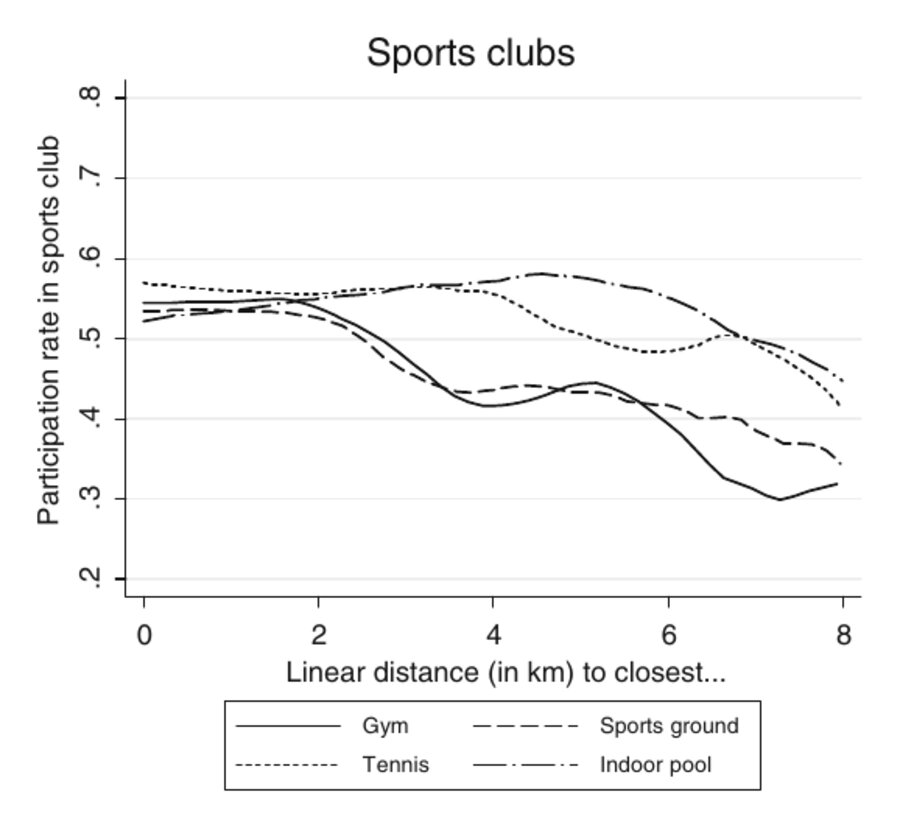
We investigate whether the distance between the next sports facilities and children’s homes matter for their sports activities inside and outside of sports clubs. Our analysis is based on a large and informative cross-section of individual data on children and their families, the so-called German Health Interview and Examination Survey for Children and Adolescents data. We use a semiparametric econometric method to investigate this relationship empirically. Our results suggest that while the distance does not matter in larger towns and cities, it does matter in smaller towns and in particular on the countryside.

BibTeX
@article{Steinmayr2011closer,
  author      = {Steinmayr, Andreas and Felfe, Christina and Lechner, Michael},
  title       = {{The Closer the Sportier? Children's Sports Activity and Their Distance to Sports Facilities}},
  journal     = {European Review of Aging and Physical Activity},
  year        = {2011},
  volume      = {8},
  number      = {2},
  pages       = {67--82},
  doi         = {10.1007/s11556-011-0090-0}
}

Policy writing and reports

Migrationspolitik durch Integrationspolitik? Politische Rationalität, ökonomische Kosten und der Bedarf an evidenzbasierter Politik

Zeitschrift für Wirtschaftspolitik, 2026, 75(1): 43–49

BibTeX
@article{Steinmayr2026migrationspolitik,
  author      = {Steinmayr, Andreas},
  title       = {{Migrationspolitik durch Integrationspolitik? Politische Rationalität, ökonomische Kosten und der Bedarf an evidenzbasierter Politik}},
  journal     = {Zeitschrift für Wirtschaftspolitik},
  year        = {2026},
  volume      = {75},
  number      = {1},
  pages       = {43--49},
  doi         = {10.1515/zfwp-2026-2003},
  langid      = {ngerman}
}

Registerdaten für bessere Entscheidungen. Neue Wege für eine evidenzbasierte Sicherheits-, Migrations- und Integrationspolitik

SIAK-Journal − Zeitschrift für Polizeiwissenschaft und polizeiliche Praxis, 2025, 4–12

Abstract

Migrations- und sicherheitspolitische Maßnahmen haben weitreichende gesellschaftliche Konsequenzen. Moderne empirische Methoden in Verbindung mit verknüpften Registerdaten ermöglichen es, die Wirkung solcher Maßnahmen präzise zu analysieren. Dieser Artikel stellt drei internationale Studien vor, die das Potenzial dieser Ansätze verdeutlichen. Eine dänische Untersuchung zeigt, wie Sozialhilfekürzungen für Geflüchtete die Arbeitsmarktintegration beeinflussen und welche unbeabsichtigten Folgen für Armut und Kriminalität entstehen. Eine britische Studie untersucht, ob Verhaftungen bei häuslicher Gewalt abschreckend wirken oder zu Vergeltungsmaßnahmen führen. Eine norwegische Analyse beleuchtet die Auswirkungen von Inhaftierungen auf Rückfälligkeit und Beschäftigung. Alle drei Studien nutzen moderne kausale Identifikationsmethoden und verknüpfte Registerdaten, um Ursache-Wirkungs-Zusammenhänge zu identifizieren. Sie demonstrieren, wie evidenzbasierte Forschung migrations- und sicherheitspolitische Entscheidungen gezielt unterstützen kann.

BibTeX
@article{Steinmayr2025registerdaten,
  author      = {Steinmayr, Andreas},
  title       = {{Registerdaten für bessere Entscheidungen. Neue Wege für eine evidenzbasierte Sicherheits-, Migrations- und Integrationspolitik}},
  journal     = {SIAK-Journal − Zeitschrift für Polizeiwissenschaft und polizeiliche Praxis},
  year        = {2025},
  number      = {2},
  pages       = {4--12},
  doi         = {10.7396/2025_2_A},
  langid      = {ngerman}
}

Herausforderungen und Chancen der Arbeitsmarktintegration ukrainischer Vertriebener in Österreich

with Dominik Duell and Valentin Wett

ifo Schnelldienst, 2024, 77(10): 31–35

BibTeX
@article{Steinmayr2024herausforderungen,
  author      = {Steinmayr, Andreas and Duell, Dominik and Wett, Valentin},
  title       = {{Herausforderungen und Chancen der Arbeitsmarktintegration ukrainischer Vertriebener in Österreich}},
  journal     = {ifo Schnelldienst},
  year        = {2024},
  volume      = {77},
  number      = {10},
  pages       = {31--35},
  url         = {https://www.ifo.de/publikationen/2024/zeitschrift-einzelheft/ifo-schnelldienst-102024-rueckkehr-oder-integration},
  langid      = {ngerman}
}

Arbeitsmarktintegration von ukrainischen Vertriebenen – mit besonderem Schwerpunkt auf Frauen

with Sarah Berens, Dominik Duell and Valentin Wett

Arbeitsmarktservice Österreich (AMS), 2024

BibTeX
@techreport{Steinmayr2024arbeitsmarktintegration,
  author      = {Steinmayr, Andreas and Berens, Sarah and Duell, Dominik and Wett, Valentin},
  title       = {{Arbeitsmarktintegration von ukrainischen Vertriebenen – mit besonderem Schwerpunkt auf Frauen}},
  institution = {Arbeitsmarktservice Österreich (AMS)},
  year        = {2024},
  url         = {https://forschungsnetzwerk.ams.at/dam/jcr:8a01e24e-bb21-42c7-a9f1-6e3d2b010c91/AMS_2024_Ukraine_Frauen-AM-Integration.pdf},
  langid      = {ngerman}
}

Coverage: ICMPD · Arbeiterkammer Wien (FORBA) · more

Menschlich, fair und akzeptiert – Ideen für die Zukunft des europäischen Asylsystems

ifo Schnelldienst, 2023, 76(10): 20–24

BibTeX
@article{Steinmayr2023menschlich,
  author      = {Steinmayr, Andreas},
  title       = {{Menschlich, fair und akzeptiert – Ideen für die Zukunft des europäischen Asylsystems}},
  journal     = {ifo Schnelldienst},
  year        = {2023},
  volume      = {76},
  number      = {10},
  pages       = {20--24},
  url         = {https://www.ifo.de/DocDL/sd-2023-10-poutvaara-etal-asylpolitik-integrationspolitik.pdf},
  langid      = {ngerman}
}

Die wirtschaftlichen Auswirkungen von Zuwanderung

Bundeszentrale für politische Bildung (bpb), Kurzdossiers, 2021

BibTeX
@misc{Steinmayr2021wirtschaftlichen,
  author      = {Steinmayr, Andreas},
  title       = {{Die wirtschaftlichen Auswirkungen von Zuwanderung}},
  howpublished = {Bundeszentrale für politische Bildung (bpb), Kurzdossiers},
  year        = {2021},
  url         = {https://www.bpb.de/themen/migration-integration/kurzdossiers/344326/die-wirtschaftlichen-auswirkungen-von-zuwanderung/},
  langid      = {ngerman}
}

The Effects of Immigration in Developed Countries: Insights from Recent Economic Research

with Anthony Edo, Lionel Ragot, Hillel Rapoport and Sulin Sardoschau

CEPII Policy Brief 22, 2018

Abstract

The rise in international migration over the past decades and particularly the recent influx of refugees to the European Union has given more audience to the economic and political consequences of immigration. A major concern in the public debate is that immigrants could take jobs from natives, reduce their wages and negatively contribute to public finances. At the same time, the rise of right-wing populist movements has brought to light that the skepticism towards immigrants and refugees may not only be based on economic but also on cultural considerations. This report is devoted to investigating these considerations by carefully relying on the existing evidence. We thus study the vast literature on the effects of immigration on the labor market and welfare system in host societies, as well as the more recent literature on the attitudinal and political consequences of immigration.

The literature on the labor market impact of immigration indicates that immigration has a negligible average impact on the wages and employment of native workers. However, because adjustments take time, particularly when immigration is unexpected, the initial and longer run impacts of immigration can differ. The average impact of immigration on public finance is also negligible, sometimes slightly positive or slightly negative. We also document that immigration can have distributional consequences. In particular, the age and educational structure of immigrants plays an important role in determining their impact on the labor market and public finances.

The fact that immigration is sometimes perceived as a factor depressing economic outcomes in host countries tends to affect native attitudes and electoral outcomes. In this regard, the literature first suggests that cultural concerns are the main driving force behind the skepticism towards immigration and that fiscal or labor market concerns only play a secondary role. Second, immigration tends to reduce the support for redistribution among native workers. Third, the effect of local level exposure to immigrants and refugees on native attitudes towards immigrants and extreme voting has been found to vary by context and can be positive or negative.

BibTeX
@techreport{Edo2018effects,
  author      = {Edo, Anthony and Ragot, Lionel and Rapoport, Hillel and Sardoschau, Sulin and Steinmayr, Andreas},
  title       = {{The Effects of Immigration in Developed Countries: Insights from Recent Economic Research}},
  institution = {CEPII},
  type        = {CEPII Policy Brief},
  number      = {22},
  year        = {2018},
  url         = {https://www.cepii.fr/PDF_PUB/pb/2018/pb2018-22.pdf}
}

Coverage: France Stratégie (Assemblée nationale) · Conseil d'analyse économique

Attracting Students to Economics: Evidence from a Natural Experiment

with Hans Fricke and Jeffrey Grogger

VoxEU.org, 2015

BibTeX
@misc{Fricke2015attracting,
  author      = {Fricke, Hans and Grogger, Jeffrey and Steinmayr, Andreas},
  title       = {{Attracting Students to Economics: Evidence from a Natural Experiment}},
  howpublished = {VoxEU.org},
  year        = {2015},
  url         = {https://cepr.org/voxeu/columns/attracting-students-economics-evidence-natural-experiment}
}

Sports and Child Development

with Christina Felfe and Michael Lechner

VoxEU.org, 2011

BibTeX
@misc{Felfe2011sports,
  author      = {Felfe, Christina and Lechner, Michael and Steinmayr, Andreas},
  title       = {{Sports and Child Development}},
  howpublished = {VoxEU.org},
  year        = {2011},
  url         = {https://cepr.org/voxeu/columns/sports-and-child-development}
}

Labour Migration and Remittances in Moldova: Is the Boom Over? Trends and Preliminary Findings from the IOM-CBSAXA Panel Household Survey 2006–2008

with Matthias Lücke and Toman Barsbai

IOM Moldova, 2009

BibTeX
@techreport{Lucke2009labour,
  author      = {Lücke, Matthias and {Omar Mahmoud}, Toman and Steinmayr, Andreas},
  title       = {{Labour Migration and Remittances in Moldova: Is the Boom Over? Trends and Preliminary Findings from the IOM-CBSAXA Panel Household Survey 2006–2008}},
  institution = {IOM Moldova},
  year        = {2009},
  url         = {https://www.researchgate.net/publication/45139917_Labour_migration_and_remittances_in_Moldova_Is_the_boom_over_Trends_and_preliminary_findings_from_the_IOM-CBSAXA_panel_household_survey_2006-_2008}
}

Book chapters

Was wir aus dem großen Flüchtlingsjahr 2015 lernen können

with Dominik Hangartner and Judith Spirig

In: So schaffen wir das. Wie wir das Thema Asyl & Migration dem linken und rechten Rand abnehmen und die Krise überwinden (eds. Othmar Karas and Judith Kohlenberger). Wien: edition a, 2023, pp. 271–282

BibTeX
@incollection{Hangartner2023fluchtlingsjahr,
  author      = {Hangartner, Dominik and Spirig, Judith and Steinmayr, Andreas},
  title       = {{Was wir aus dem großen Flüchtlingsjahr 2015 lernen können}},
  booktitle   = {{So schaffen wir das. Wie wir das Thema Asyl \& Migration dem linken und rechten Rand abnehmen und die Krise überwinden}},
  editor      = {Karas, Othmar and Kohlenberger, Judith},
  publisher   = {edition a},
  address     = {Wien},
  year        = {2023},
  pages       = {271--282},
  url         = {https://www.edition-a.at/buecher/wissenschaft/172/so-schaffen-wir-das},
  langid      = {ngerman}
}

Die Österreicher/-innen und der Wandel in der Arbeitswelt

with Gudrun Biffl, Katharina Renner, Justyna Okolowicz and Ursula Hamachers-Zuba

In: Die Österreicher/-innen. Wertewandel 1990–2008 (eds. Ursula Hamachers-Zuba, Christian Friesl and Regina Polak). Wien: Czernin, 2009, pp. 37–86

BibTeX
@incollection{Biffl2009osterreicher,
  author      = {Biffl, Gudrun and Renner, Katharina and Okolowicz, Justyna and Steinmayr, Andreas and Hamachers-Zuba, Ursula},
  title       = {{Die Österreicher/-innen und der Wandel in der Arbeitswelt}},
  booktitle   = {{Die Österreicher/-innen. Wertewandel 1990–2008}},
  editor      = {Hamachers-Zuba, Ursula and Friesl, Christian and Polak, Regina},
  publisher   = {Czernin},
  address     = {Wien},
  year        = {2009},
  pages       = {37--86},
  url         = {https://www.czernin-verlag.com/buch/dieoesterreicherinnen},
  langid      = {ngerman}
}

Work in progress

  • The Economics of Family-Based Migration

    with Toman Barsbai and Sebastian Kupek

  • Labor-Market Information, Job Postings, and Employer Beliefs: Experimental Evidence from Austria

    with Sebastian Butschek, Mattis Gilbert, Roland Rathelot and Marina Schwab

  • Uneven Rules: The Struggle for Refugee Family Reunification

    with Katia Gallegos Torres and Valentin Wett

Research funding

  • 2025–2026Arbeitsmarktintegration von Geflüchteten – Hemmnisse und Wegbereiter · Arbeitsmarktservice Österreich (AMS)
  • 2023–2024Arbeitsmarktintegration von Geflüchteten aus der Ukraine mit besonderem Schwerpunkt auf Frauen · Arbeitsmarktservice Österreich (AMS)
  • 2023–2027Do Firms Lack Information about Their Own Labor Market? · Anniversary Fund of the Oesterreichische Nationalbank (OeNB)
  • 2018–2020Scholarship of the Bavarian Academy of Sciences and Humanities · Bavarian Academy of Sciences and Humanities
  • 2017–2019LMUexcellent Junior Researcher Fund · LMU Munich
  • 2016Department of Economics Research Fund · LMU Munich, Department of Economics
  • 2013–2024Harnessing the Development Benefits of International Migration: A Randomized Evaluation of Enhanced Pre-Departure Orientation Seminars for Migrants from the Philippines · International Initiative for Impact Evaluation (3ie)
  • 2013–2014Early Postdoc Mobility Scholarship · Swiss National Science Foundation (SNSF)