

Andreas Steinmayr

Professor of Empirical Economics
Department of Public Finance, Faculty of Economics and Statistics, University of Innsbruck

I am a labor economist at the University of Innsbruck. Much of my research is on migration and the integration of refugees and other migrants; I also work on hiring and job search, education and health decisions, and methods for causal inference.

Previously, I was Assistant Professor at LMU Munich and a visiting scholar at the University of Chicago. I received my PhD from the University of St. Gallen.

Research areas Labor Economics · Economics of Migration · Political Economy · Economics of Education · Applied Econometrics and Causal Inference

Portrait of Andreas Steinmayr
Photo: Target Group / Franz Oss

News

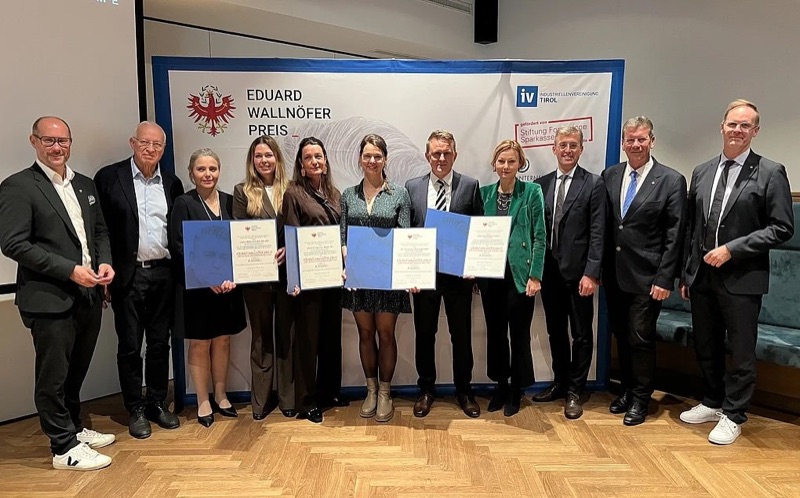
Group photo of the prize winners and hosts at the Eduard Wallnöfer Prize 2026 ceremony; Andreas Steinmayr, fifth from the right, holds Valentin Wett's certificate.
Photo: Industriellenvereinigung Tirol

28 Oct 2026

Wallnöfer Prize 2026 for Valentin Wett's dissertation

Valentin Wett received the Eduard Wallnöfer Prize 2026 in the category "Society, Mind and Future" for his dissertation on the labor market integration of refugees in Austria, which I supervised. As he was abroad on the day of the ceremony, I had the pleasure of accepting the certificate on his behalf.

More

Using linked Austrian administrative data and quasi-experimental methods, the dissertation estimates the causal effects of local labor demand, welfare benefits and early access to apprenticeships on refugees' employment. Early access to an apprenticeship in a shortage occupation improves employment trajectories in the long run, and a receptive local labor market affects whether refugees stay in the region they were assigned to. The level of welfare benefits has only a small effect on employment and on staying. Congratulations, Valentin!
13 Oct 2026

Podcast: cause and effect on Erklär mir die Welt

In episode 410 of Andreas Sator's podcast "Erklär mir die Welt", I talk about cause and effect: why data alone never tell us what causes what, and why it pays to think about parallel universes and perfect clones. The episode is in German.

More

We ask about cause and effect more often than we realise. Will a university degree get me a better job than an apprenticeship? Will my child do better at school after joining a sports club or learning an instrument? And in policy: do training programmes of the Public Employment Service help unemployed people find jobs? Does voting change in a municipality when refugees are housed there? Over the past decades, research has developed methods and a language to think about such questions more systematically.

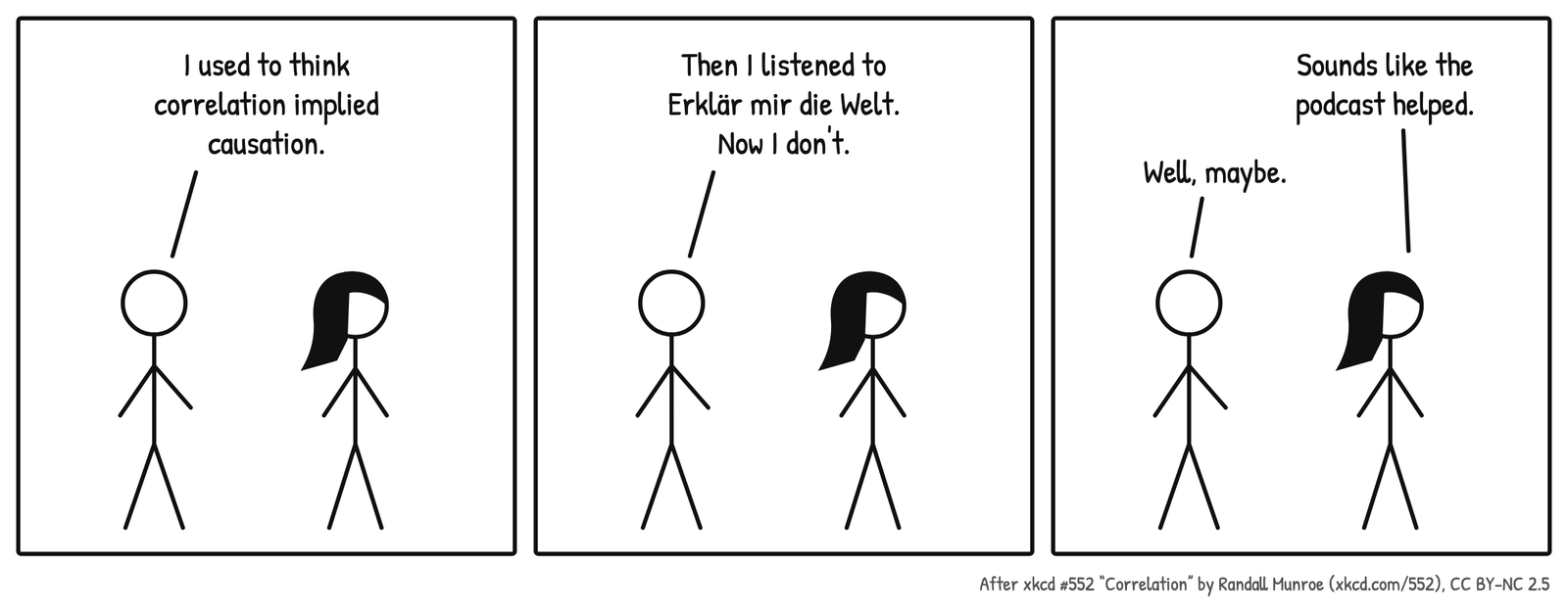
Many thanks to Andreas Sator for having me on a podcast I enjoy listening to myself. And here is a joke that makes more sense after listening to the episode:

Three-panel stick-figure comic. Panel 1: I used to think correlation implied causation. Panel 2: Then I listened to Erklär mir die Welt. Now I don't. Panel 3: Sounds like the podcast helped. Well, maybe.
After xkcd #552 “Correlation” by Randall Munroe (xkcd.com/552), CC BY-NC 2.5.

8 Oct 2026

Interview with top.tirol on tax breaks for working pensioners

I spoke with top.tirol about the planned tax relief for people who keep working past retirement age. Much of the benefit goes to those who already work in retirement, which makes this a rather expensive policy.

18 Sep 2026

Innsbruck–Munich Workshop on Empirical Economic Research 2026

Together with Joachim Winter (LMU Munich), I organized this year's workshop in Maria Waldrast, where junior researchers from Innsbruck and Munich presented their ongoing work.

More

Thirteen participants from the University of Innsbruck and LMU Munich discussed empirical projects on migration and integration, labor markets and active labor market policy, health and human capital, and public finance and political economy. A plenary discussion focused on the use of AI in empirical economic research. We thank the Research Area Economy, Politics and Society (EPoS) for its financial support.

Current projects

Arbeitsmarktintegration von Geflüchteten – Hemmnisse und Wegbereiter

Arbeitsmarktservice Österreich (AMS) · 2025–2026

Do Firms Lack Information about Their Own Labor Market?

Anniversary Fund of the Oesterreichische Nationalbank (OeNB) · 2023–2027