The Effect of Labor Migration on the Diffusion of Democracy: Evidence from a Former Soviet Republic
American Economic Journal: Applied Economics, 2017, 9(3): 36–69
Abstract
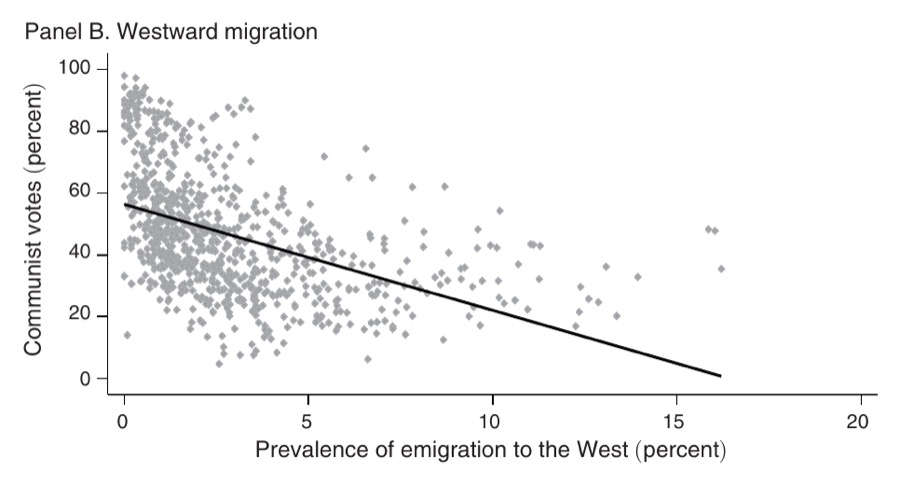
Migration contributes to the circulation of goods, knowledge, and ideas. Using community and individual-level data from Moldova, we show that the emigration wave that started in the aftermath of the Russian crisis of 1998 strongly affected electoral outcomes and political preferences in Moldova during the following decade, eventually contributing to the fall of the last Communist government in Europe. Our results are suggestive of information transmission and cultural diffusion channels. Identification relies on the quasi-experimental context and on the differential effects arising from the fact that emigration was directed both to more democratic Western Europe and to less democratic Russia.
Cite (BibTeX)
@article{Barsbai2017effect,
  author      = {Barsbai, Toman and Rapoport, Hillel and Steinmayr, Andreas and Trebesch, Christoph},
  title       = {{The Effect of Labor Migration on the Diffusion of Democracy: Evidence from a Former Soviet Republic}},
  journal     = {American Economic Journal: Applied Economics},
  year        = {2017},
  volume      = {9},
  number      = {3},
  pages       = {36--69},
  doi         = {10.1257/app.20150517}
}Awards
- Prize for Scientific Excellence, Research Group on Development Economics of the German Economic Association
Earlier versions
- IZA Discussion Paper No. 7980 (2014)
- CESifo Working Paper No. 4389 (2013)
- Kiel Working Paper No. 1869 (2013)