The Effects of Incentives to Exercise on Student Performance in College
Economics of Education Review, 2018, 66: 14–39
Abstract
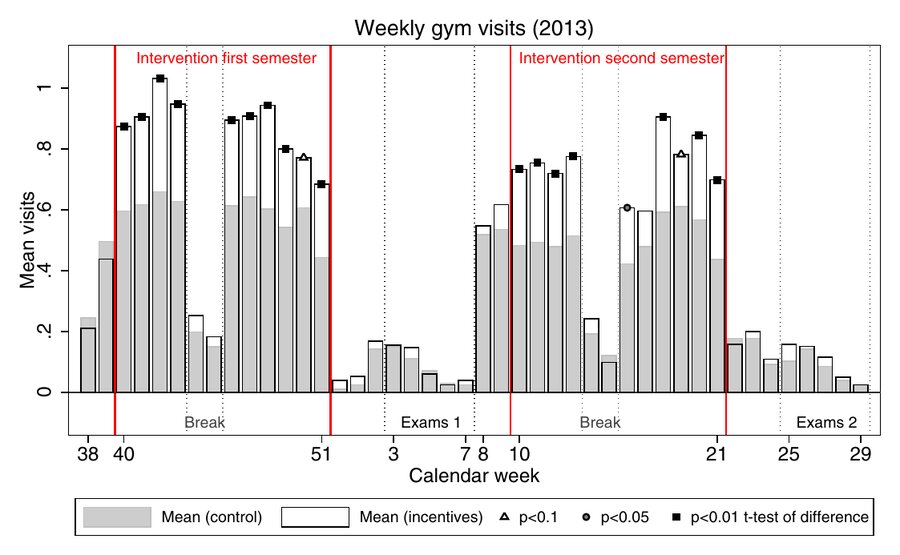
What are the effects of on-campus recreational sports and exercise on educational outcomes of university students? We randomize financial incentives to encourage students’ participation in on-campus sports and exercise in two cohorts of college freshmen. Incentives increased participation frequency by 47% and improved grades by 0.14 standard deviations in the first cohort. The incentives were less effective in promoting participation and did not improve grades in the second cohort. In the first cohort, students primarily substituted off-campus with on-campus physical activities and seemed more able to integrate exercising with studying. The incentives appear to have improved grades by enhancing the effectiveness of studying and encouraging students to spend more time in class.
Cite (BibTeX)
@article{Fricke2018effects,
  author      = {Fricke, Hans and Lechner, Michael and Steinmayr, Andreas},
  title       = {{The Effects of Incentives to Exercise on Student Performance in College}},
  journal     = {Economics of Education Review},
  year        = {2018},
  volume      = {66},
  pages       = {14--39},
  doi         = {10.1016/j.econedurev.2018.06.009}
}Earlier versions
- CEPR Discussion Paper No. 12052 (2017), "The Effect of Physical Activity on Student Performance in College: An Experimental Evaluation"