Contact versus Exposure: Refugee Presence and Voting for the Far Right
The Review of Economics and Statistics, 2021, 103(2): 310–327
Abstract
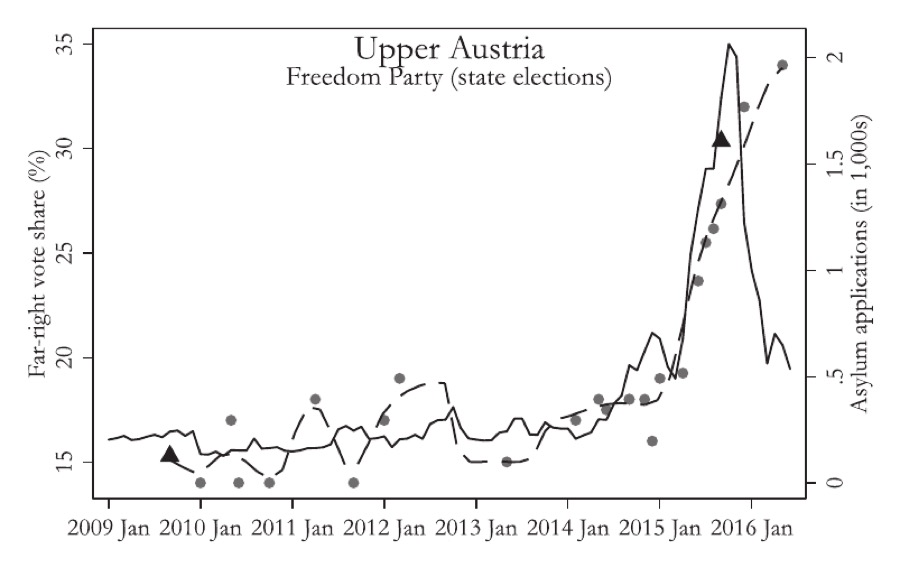
This paper investigates how different forms of exposure to refugees affect voting for Far Right parties. I study the state of Upper Austria where many municipalities hosted asylum seekers and also experienced a massive flow of refugees crossing into Germany in 2015. Exposure to refugees passing through border municipalities increased Far Right votes by about 1.5 percentage points, which suggests that mere exposure can increase Far Right support. Conversely, contact and sustained interactions between natives and asylum seekers in hosting municipalities decreased Far Right votes by about 4 percentage points, which is in line with the intergroup contact theory.
Cite (BibTeX)
@article{Steinmayr2021contact,
  author      = {Steinmayr, Andreas},
  title       = {{Contact versus Exposure: Refugee Presence and Voting for the Far Right}},
  journal     = {The Review of Economics and Statistics},
  year        = {2021},
  volume      = {103},
  number      = {2},
  pages       = {310--327},
  doi         = {10.1162/rest_a_00922}
}Awards
- Young Economists' Award of the Austrian Economic Association (NOeG)
Earlier versions
- IZA Discussion Paper No. 9790 (2016), "Exposure to Refugees and Voting for the Far-Right: (Unexpected) Results from Austria"
- Earlier title: "Contact Matters: Exposure to Refugees and Voting for the Far-Right"