Immigrating into a Recession: Evidence from Family Migrants to the United States
Journal of Labor Economics, 2025, 43(3): 843–883
Abstract
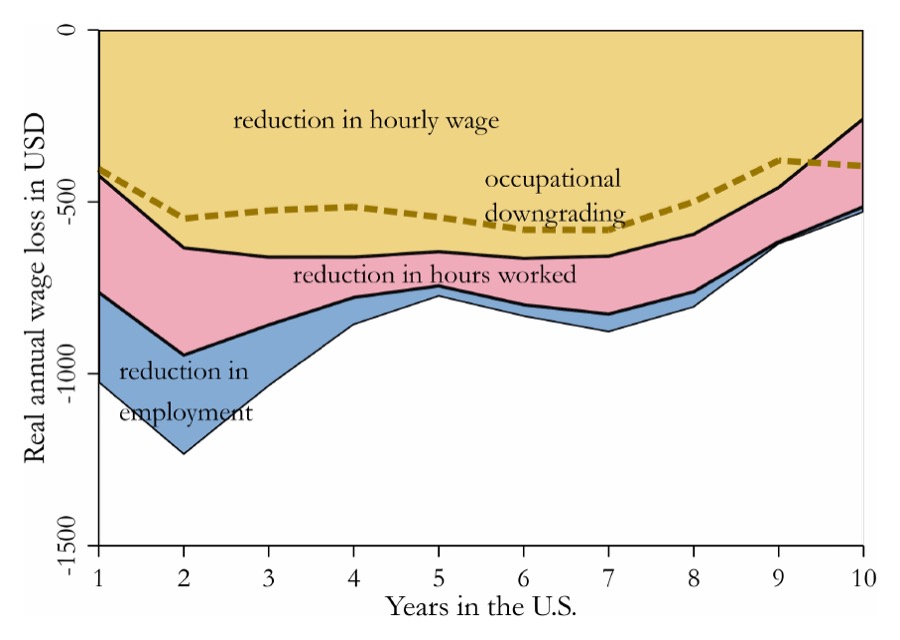
We analyze the impact of economic conditions at arrival on the economic integration of family-sponsored migrants in the United States. A 1 percentage point higher unemployment rate at arrival decreases annual wage income by 4% in the short run and 2% in the longer run. The loss in wage income results primarily from lower hourly wages due to occupational downgrading. Migrant and family networks help mitigate the negative labor market effects. Migrants who arrive during a recession take up occupations with higher concentrations of fellow countrypeople and are more likely to reside with family members, potentially reducing their geographical mobility.
Cite (BibTeX)
@article{Barsbai2025immigrating,
  author      = {Barsbai, Toman and Steinmayr, Andreas and Winter, Christoph},
  title       = {{Immigrating into a Recession: Evidence from Family Migrants to the United States}},
  journal     = {Journal of Labor Economics},
  year        = {2025},
  volume      = {43},
  number      = {3},
  pages       = {843--883},
  doi         = {10.1086/730121}
}Earlier versions
- Working Papers in Economics and Statistics, University of Innsbruck, No. 2022-01 (2022), "Immigrating into a Recession: Evidence from Family Migrants to the U.S."
- CReAM Discussion Paper No. 01/22 (2022)
- Kiel Working Paper No. 2240 (2023)
Blogs and research summaries
Presented at
- Invited seminar, Amsterdam
- NBER Conference: Immigrants and the U.S. Economy
- 11th Annual International Conference on Immigration in OECD Countries, Esch-sur-Alzette
- IHS Workshop Arbeitsmarktökonomie 2021, Vienna
- Invited seminar, Lund
- Annual Conference of the Canadian Economics Association