Research · Working paper
The Wage Penalty of Regional Accents
NBER Working Paper 26719, 2020
Abstract
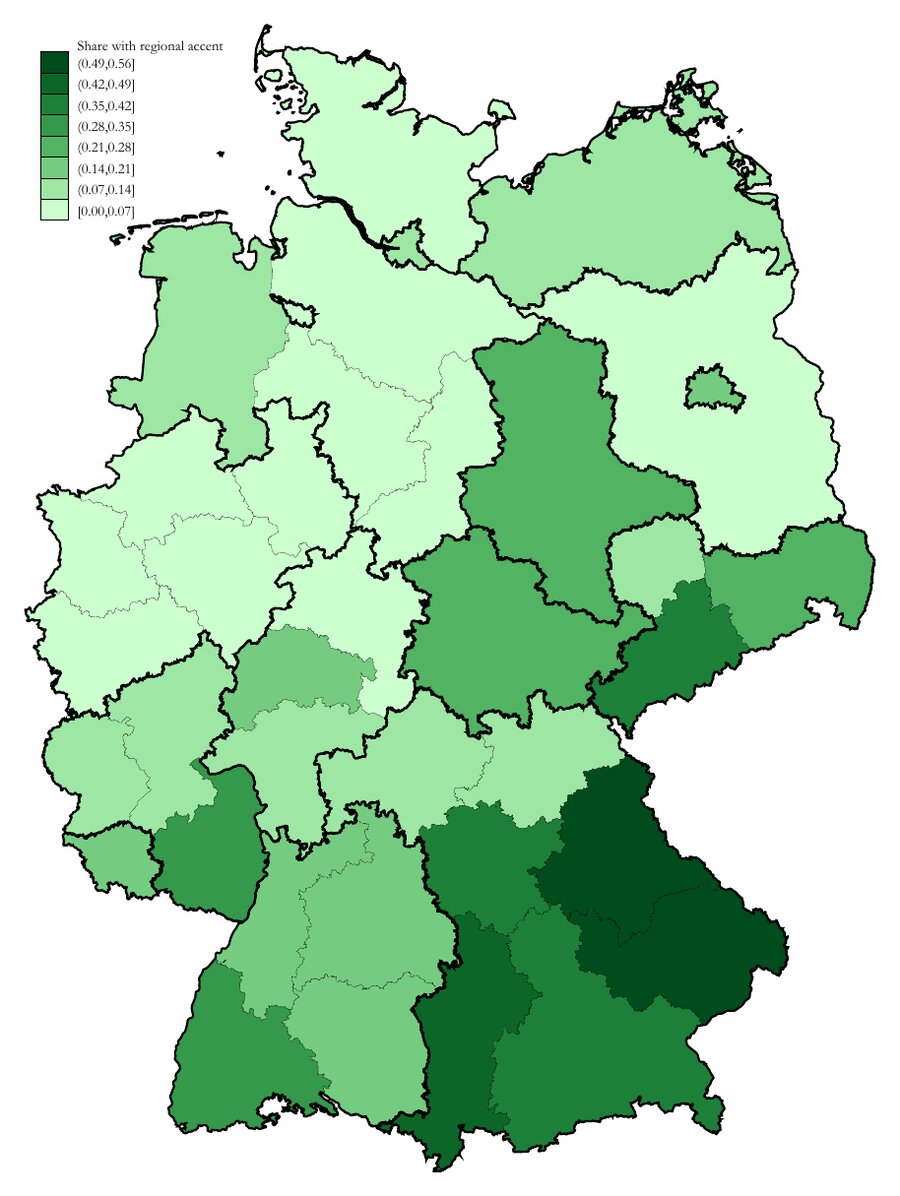
Previous work has documented that speaking one’s native language with an accent distinct from the mainstream is associated with lower wages. In this study, we seek to estimate the causal effect of speaking with a distinctive regional accent, disentangling the effect of the accent from that of omitted variables. We collected data on workers’ speech in Germany, a country with wide variation in regional dialects. We use a variety of strategies in estimation, including an instrumental variables strategy in which the instruments are based on research findings from the linguistics of accent acquisition. All of our estimators show that speaking with a distinctive regional accent reduces wages by an amount that is comparable to the gender wage gap. We also find that workers with distinctive regional accents tend to sort away from occupations that demand high levels of face-to-face contact, consistent with various occupational sorting models.
Cite (BibTeX)
@techreport{Grogger2020wage,
  author      = {Grogger, Jeffrey and Steinmayr, Andreas and Winter, Joachim},
  title       = {{The Wage Penalty of Regional Accents}},
  institution = {National Bureau of Economic Research},
  type        = {NBER Working Paper},
  number      = {26719},
  year        = {2020},
  doi         = {10.3386/w26719}
}Earlier versions
- CRC TRR 190 Discussion Paper No. 184 (2019)
In the media
- Why workers with regional accents make less money
- Prüfers Kolumne: Menschen mit Dialekt sind besonders verträglich – und sollten bevorzugt eingestellt werden
- Wer Dialekt spricht, bekommt 20 Prozent weniger Gehalt
- Studie: Weniger Gehalt bei Dialekt
- Einkommen: Wer Dialekt spricht, verdient 20 Prozent weniger